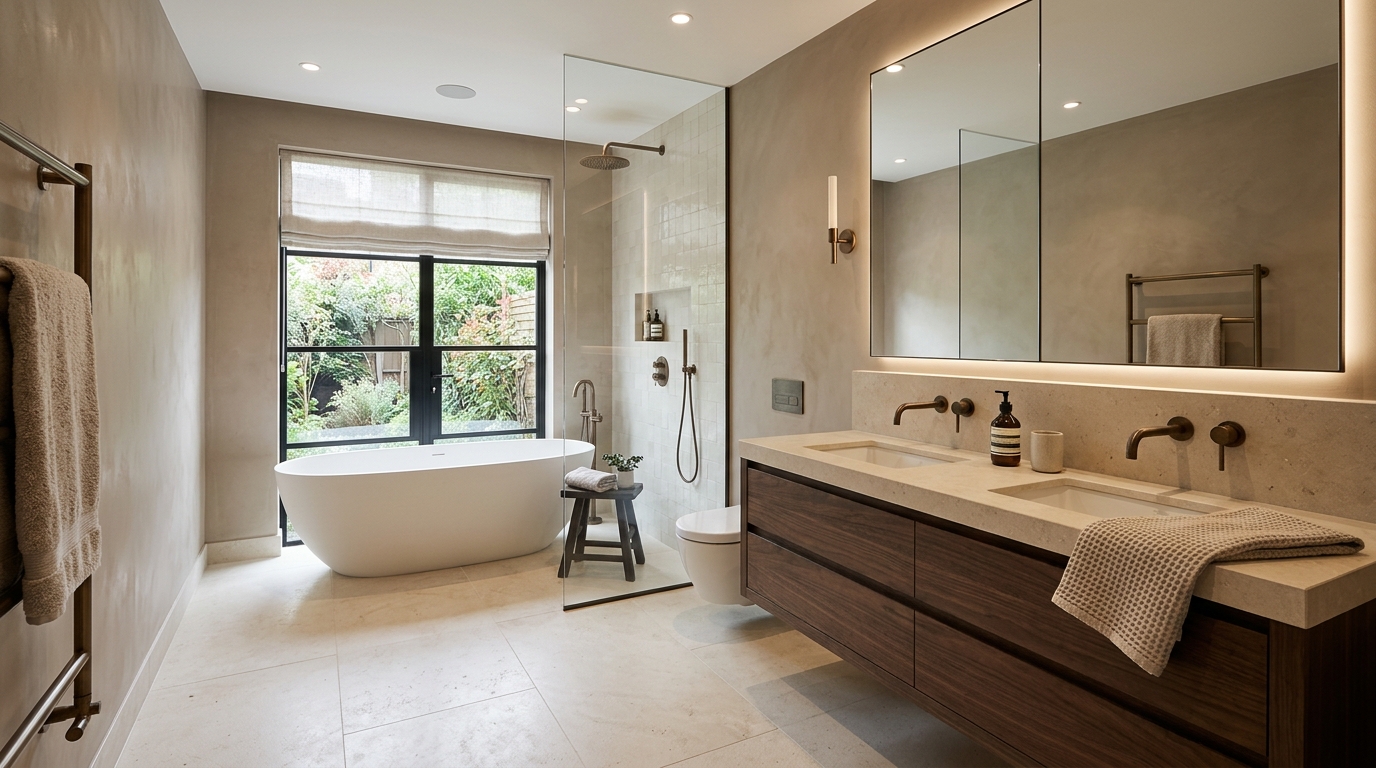
A private residential steam shower is among the most sought-after amenities in luxury Manhattan master suites. Transporting the wellness experience of a high-end spa into a private home requires generating continuous 110°F to 118°F vapor at nearly 100% relative humidity.
However, from a building physics perspective, steam behaves completely differently from liquid shower water. Liquid water flows downward under gravity across tile surfaces toward the drain. Steam, on the other hand, is an energized gas under positive vapor pressure. Driven by thermal differentials between the hot shower enclosure and the cooler bathroom and wall cavity, water vapor forces its way through porous grout, micro-cracks, and standard waterproofing membranes.
When steam penetrates building partitions, it condenses inside structural stud bays, rusting light-gauge steel framing, rotting wood sleepers, and causing catastrophic blistering and mold in the neighbor's adjoining plaster wall.
At TRD Builders, our architectural and MEP engineering team treats every steam enclosure as an airtight, vapor-impermeable environmental chamber. Here is our engineering protocol for building trouble-free luxury steam showers in high-end New York residential buildings.
The Physics of Vapor Drive & ASTM E96 Permeance Ratings
Water vapor transmission through building materials is quantified in "perms" under ASTM E96 standards. The lower the perm rating, the more resistant the material is to vapor diffusion:
| Material / Waterproofing Layer | Perm Rating (ASTM E96) | Steam Shower Suitability | | :--- | :--- | :--- | | Standard Cement Backer Board (Durock, WonderBoard) | 10.0 to 15.0 perms | Unacceptable (requires complete vapor membrane) | | Standard Liquid-Applied Membrane (RedGard, Hydro Ban) | 1.0 to 3.0 perms | Inadequate for steam (allows significant vapor drive) | | High-Performance Liquid Vapor Retarder (Mapei Mapelastic AquaDefense) | 0.4 to 0.7 perms | Borderline / Light-duty residential only | | Sheet Membrane (Schluter-KERDI) | 0.9 perms | Light-duty steam only | | Specialized Steam Membrane (Schluter-KERDI-DS) | 0.18 perms | Approved (Engineered for continuous steam) | | Sheet Lead or Bonded Copper Pan Systems | < 0.05 perms | Excellence (Pre-war co-op gold standard) |
For true residential steam applications, the Tile Council of North America (TCNA) Handbook Details SR613 and SR614 mandate a continuous vapor retarder with a perm rating of 0.5 perms or less, with luxury high-use residential enclosures targeting under 0.2 perms.
Standard liquid-applied shower membranes that are perfectly adequate for normal domestic showers will break down under the high temperature and relentless vapor drive of a residential steam generator.
Critical Architectural Detailing: Ceiling Slope & Thermal Isolation
Engineered steam rooms require specialized geometry to prevent uncomfortable condensation rain and thermal energy loss:
Ceiling Condensation Slope (2 Inches per Foot)
As hot water vapor rises and contacts the cooler ceiling tile, it rapidly condenses into water droplets. On a flat ceiling, these cold condensation drops gather and drip down onto the bather. Under TCNA standards and TRD design guidelines, the ceiling must be pitched at a minimum slope of 2 inches per horizontal foot (or a gentle center arch/barrel vault). This slope utilizes surface tension to guide condensed water smoothly down the perimeter walls into the floor drain without dripping.
Continuous Envelope Thermal Break
Pre-war exterior brick walls and uninsulated concrete slabs act as major thermal heat sinks. If a steam shower's backer board is mounted directly against an exterior wall or uninsulated concrete slab, the extreme temperature gradient accelerates condensation behind the tile and drains generator capacity. We install continuous closed-cell extruded polystyrene (XPS) structural insulation boards or mineral wool thermal breaks behind the substrate, ensuring the interior tile reaches steam temperature quickly with minimal energy waste.
Hermetically Sealed Doors & Vapor-Tight Transitions
The shower enclosure must be completely sealed up to the ceiling with silicone vapor-barrier gaskets. Transom glass panels above the door must feature adjustable pivot seals, allowing bathers to vent residual steam through dedicated exhaust systems once the session concludes. Recessed lighting must be wet-location IP65/IP67 rated, with silicone-sealed vapor lenses preventing vapor entry into ceiling plenum cavities.
Mechanical Engineering: Sizing the Steam Generator & Plumbing
A properly functioning steam shower depends on precise generator sizing and dedicated plumbing infrastructure:
ROOM CUBIC VOLUME (L × W × H)
      × Wall Surface Factor (Glass / Acrylic = 1.15 | Ceramic Tile = 1.20 | Natural Stone / Marble = 2.0)
      × Exterior Wall Factor (One exterior wall = 1.10 | Two exterior walls = 1.20)
      × Ceiling Height Factor (Over 8 ft = +15% per foot)
      ─────────────────────────────────────────────────────────────
      = TOTAL REQUIRED GENERATOR POWER (kW)
Because natural marble, granite, and cast stone slabs absorb vast amounts of thermal energy compared to ceramic tile, installing 3/4-inch marble slabs without up-sizing the generator will result in a lukewarm, wet room rather than dense, invigorating steam.
Plumbing Infrastructure Protocols:
- Dedicated Cold Water Supply with Backflow Prevention: Sourced with a local ball valve shut-off and inline sediment filter to prevent mineral scaling inside the heating tank.
- Auto-Flush Drain Down Systems: High-end units (ThermaSol, MrSteam, Amerec) must feature automated gravity drain-down valves that flush stagnant water and calcified minerals after every operation, extending heating element lifespan.
- Safety Steam Head Placement: Steam heads discharge vapor at over 212°F. They must be mounted 6 to 12 inches above the finished shower floor, positioned away from bathers' seated seating areas, and equipped with a cool-to-the-touch aromasteam safety shield.
Collaboration with Master Tile Artisans & Interior Finishers
Applying multi-thousand-dollar bookmatched marble slabs or delicate glass mosaics over a vapor-proof steam membrane requires specialized artisan skills. A single fastener penetrating the vapor barrier without an elastomeric seal will breach the entire containment envelope.
At TRD Builders, our in-house engineers design the complete waterproofing enclosure, calculate generator loads, and handle co-op board submissions and DOB plumbing permits. We work synergistically with elite residential general contractors and stone specialists—such as KS Renovation Group and master tile artisans—who handle the delicate installation of bookmatched stone, epoxy grouting (ANSI A118.3), and custom frameless glass enclosures.
By uniting licensed mechanical and structural engineering with fine European stone craftsmanship, luxury steam showers deliver flawless spa-quality relaxation with lifetime structural security.